
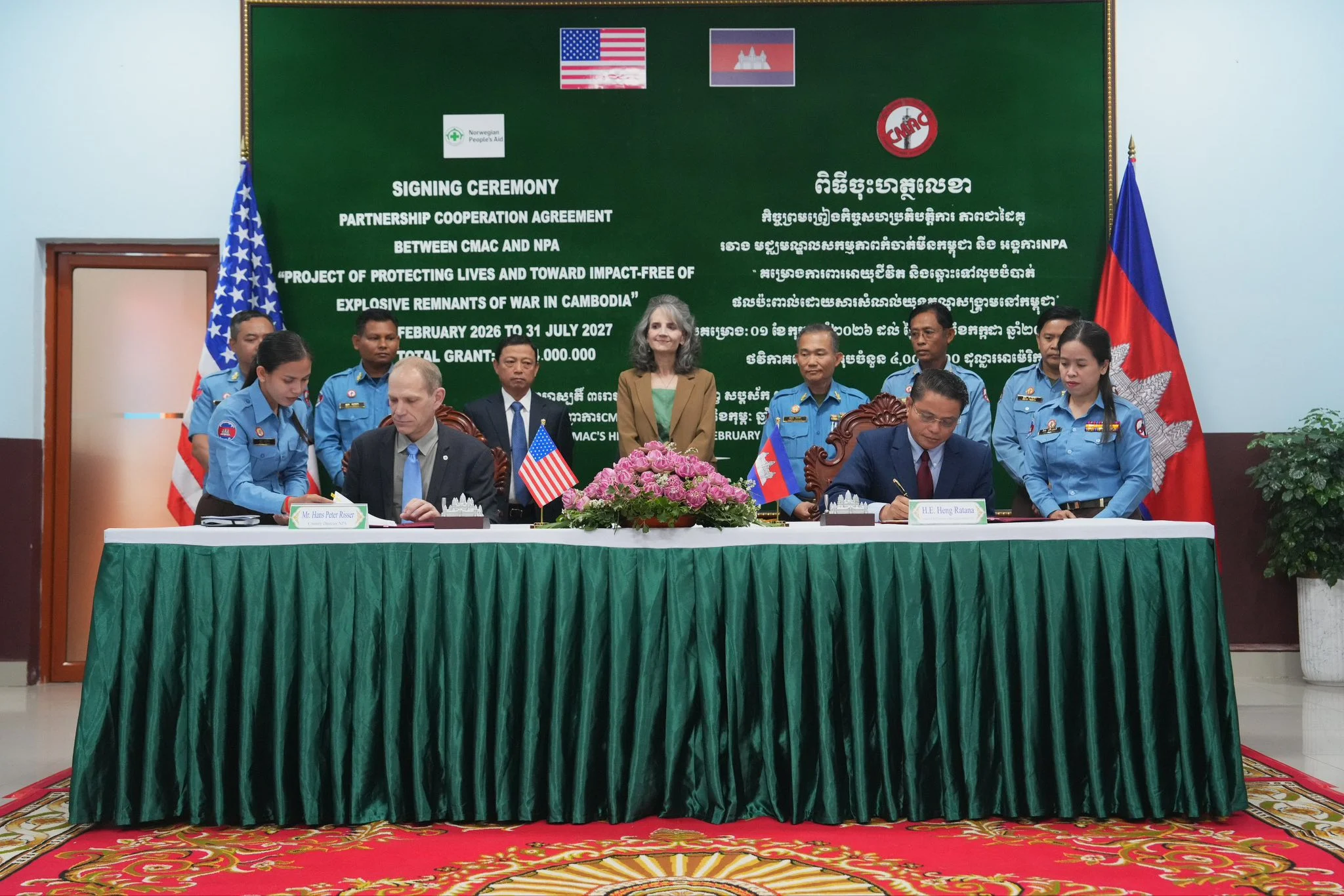
Phnom Penh, Cambodia – The United States has committed $5 million in aid to support critical demining efforts in Cambodia. This significant funding will be allocated to the Cambodian Mine Action Centre (CMAC) and the Norwegian People’s Aid (NPA) to facilitate the clearance of cluster bombs and landmines, as well as to address other residual explosive ordnance threats across the country. According to Mr. Heng Ratana, Director General of CMAC, the project will primarily focus its operations within Oddar Meanchey province.
The partnership cooperation agreement was formally signed on February 5th by Mr. Heng Ratana and Mr. Hans Peter Risser, the Country Director for NPA, with Ms. Kelly Saltzman, Political Affairs Associate at the U.S. Embassy in Cambodia, in attendance. Mr. Ratana announced the agreement via a post on social media. Out of the total $5 million aid package provided by the U.S. government, CMAC is set to receive $4 million, while NPA will receive $1 million. This crucial 18-month project, dedicated to clearing cluster bombs, landmines, and other residual explosive threats, is scheduled for implementation from February 2026 until the end of July 2027. The initiative aims to effectively eliminate the risks posed by mines and unexploded ordnance, thereby restoring the livelihoods of affected communities, fostering economic growth, and enhancing overall welfare.
Mr. Ratana further elaborated that the project is designed to bolster the capabilities of approximately 300 CMAC specialists. These personnel will be deployed across two mine clearance units, operating in the Tboung Khmum and Oddar Meanchey provinces, which are directly responsible for executing the operations. The CMAC Director highlighted the extensive impact of past border conflicts, specifically those caused by the Thai military in 2025, which have led to considerable contamination on Cambodian territory. He noted that cluster bombs, bombs dropped from aircraft or drones, chemical weapons, and other ordnance deployed by the Thai military have collectively threatened the safety of an area covering 441,595 hectares. This vast area spans 340 villages, affecting 91,411 households, equating to 364,694 individuals across seven provinces bordering Thailand. While the threat is widespread, Mr. Ratana reaffirmed that the current project will prioritize Oddar Meanchey province, where an estimated 40,400 hectares across 145 villages are suspected to be affected. Beyond financial assistance, the U.S. government is also committed to providing crucial support in terms of materials, technical expertise, and human resource capacity building for these vital demining operations.