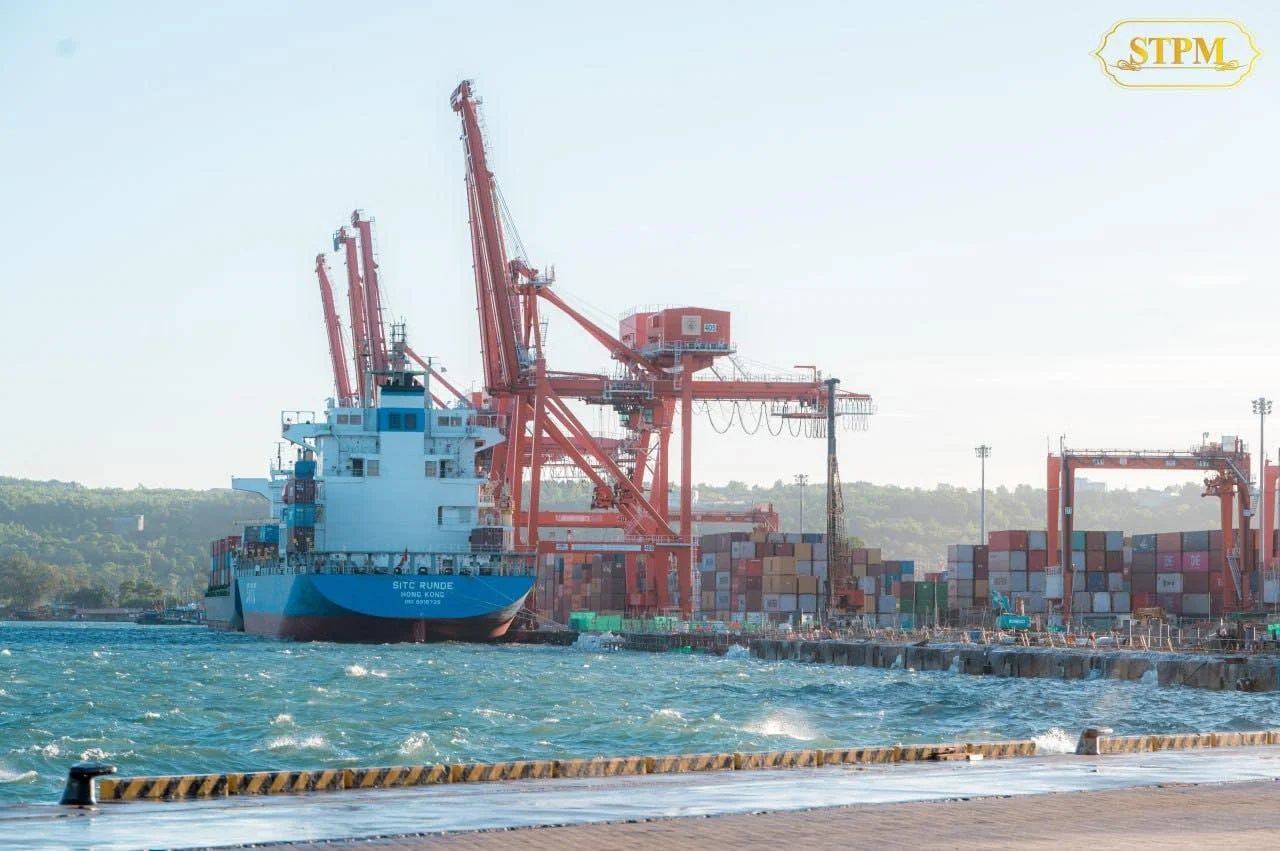
Phnom Penh, Cambodia – Sihanoukville Autonomous Port (PAS), Cambodia’s largest cargo gateway, is poised for substantial growth, with projections indicating over 12 million tons of goods will pass through its facilities in 2025. This anticipated volume represents a notable 25.78 percent increase compared to the previous year, 2024, according to the latest annual report from the Ministry of Public Works and Transport.
The Ministry’s detailed report outlines that the total cargo throughput for Sihanoukville Autonomous Port in 2025 is expected to reach precisely 12,323,414 tons. This comprises 9,128,081 tons of imports and 3,195,333 tons of exports, highlighting the port’s critical role in Cambodia’s international trade. Furthermore, specific commodity forecasts include 2,064,534 tons of fuel imports and an additional 218,034 tons of gas imports for the year.
Beyond general cargo, the report also projects significant increases in container traffic and vessel calls. In 2025, the port is expected to handle 1,347,726 TEUs (Twenty-foot Equivalent Units), marking a substantial 30.35 percent rise from 2024 figures. Concurrently, the number of vessels calling at the port is set to increase by 13.35 percent, reaching a total of 1,775 ships. Financially, Sihanoukville Port anticipates generating $151.58 million in revenue for 2025, reflecting a 35.33 percent increase. It is important to note, however, that this revenue figure is currently unaudited.
Driving much of this expansion and future growth is the ongoing development of a new deepwater container terminal. Phase 1 of this ambitious project involves constructing a 350-meter-long terminal with a crucial water depth of 14.5 meters. This initial phase is currently 51.21 percent complete, funded by a loan package totaling approximately $243 million, and is slated for completion by the end of 2026.
Mr. Lou Kim Chhun, Director General of Sihanoukville Autonomous Port, emphasized the transformative impact of this deepwater terminal. Once operational, it will enable the port to accommodate container vessels with a capacity of up to 60,000 tons (equivalent to 4,000 TEUs) from major Asia-Pacific shipping routes. This will dramatically boost the port’s annual handling capacity to 1.45 million TEUs. Critically, it will allow approximately 93 percent of regional vessels to dock at Sihanoukville Port, a significant leap from the current 18 percent.
The enhancement in port capabilities is also expected to yield considerable economic benefits. Mr. Lou Kim Chhun highlighted that the official launch of the deepwater container terminal could reduce sea freight costs by an estimated $200 USD per TEU. This cost reduction is comparable to shipping rates in other regional countries, thereby substantially enhancing Cambodia’s competitive edge in international trade and logistics.
Looking ahead, the Royal Government has outlined plans for further expansion with Phase 2 and Phase 3 of the deepwater container terminal project. Phase 2 will extend the terminal by 400 meters, increasing the water depth to 16.5 meters. This will allow the port to handle 120,000-ton vessels (10,000 TEUs) from Indo-Pacific shipping routes, elevating the total port capacity to over 1.8 million TEUs per year.
Phase 3, the final stage, will add another 430 meters, bringing the water depth to 17.5 meters. This advanced phase is designed to accommodate massive 160,000-ton vessels (15,000 TEUs) from global shipping routes, including Europe and the Americas. This will eliminate the need for these larger ships to transit through other regional ports before reaching Cambodia. Upon completion of Phase 3, Sihanoukville Autonomous Port’s total annual capacity is projected to reach an impressive 2.5 million TEUs.
The combined construction costs for Phase 2 and Phase 3 are estimated at an additional $698 million. This brings the total investment for all three phases of the Sihanoukville Port expansion to approximately $941 million.
Feasibility studies underscore that the completion of all three phases will fundamentally transform Sihanoukville Autonomous Port. Currently categorized as a small international port, it will evolve into a large, highly competitive international hub. This will ensure that large container vessels from any part of the world can dock easily and efficiently, removing previous constraints related to water depth and solidifying Sihanihanoukville’s position as a pivotal maritime gateway in the region and beyond.