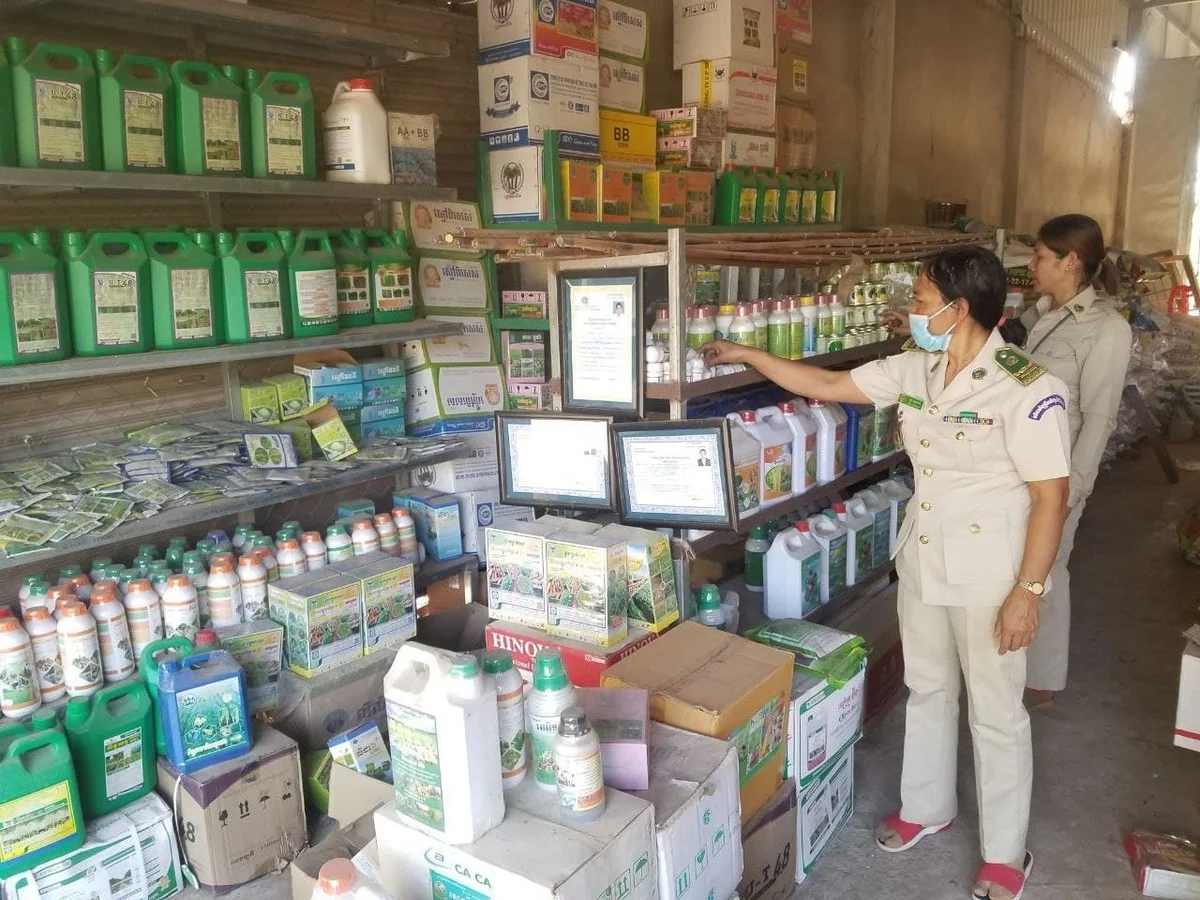
Phnom Penh, Cambodia – For the entirety of 2025, Cambodia is projected to spend an estimated $636 million on importing agricultural inputs, encompassing both fertilizers and pesticides, primarily from neighboring countries. A significant portion of this expenditure, approximately $419 million, is allocated specifically for the import of agricultural fertilizers. These figures are based on data released by the Ministry of Commerce.
Further breakdown of the trade data from the Ministry of Commerce indicates that the $419.83 million spent on imported agricultural fertilizers represents a 6.64% increase compared to 2024, when the import value stood at $393.70 million. In contrast, the import of pesticides and herbicides for the agricultural sector amounted to $217.80 million, showing a slight decrease of over 1%. The majority of these agricultural inputs are sourced from countries such as Vietnam, Thailand, South Korea, Japan, and China.
Fertilizer is recognized as an indispensable input for crop cultivation, second only to seeds, and plays a critical role in agricultural production. This reliance has prompted calls for greater scrutiny. Senator Mong Reththy, Chairman of the 3rd Commission of the Senate, previously urged the government to enhance oversight on imported fertilizers. Agricultural business leaders have echoed this sentiment, highlighting past instances where imported fertilizers proved ineffective, leading to lower yields for farmers despite high production costs.
Addressing this critical issue, Prime Minister Hun Manet has strongly advocated for Cambodia’s agricultural sector to reduce its heavy dependence on imported fertilizers. During a joint session of the National Assembly and Senate on the evening of June 3, 2025, the Prime Minister emphasized the strategic importance of self-sufficiency. He stated, “Relying on others for our breath means that one day, if they wish to harm us, they could simply manipulate fertilizer prices, and we would suffer. If fertilizer imports are halted, we would lack the capacity. We must strive to develop our own fertilizer production capabilities.”
For Cambodia, fertilizer transcends being merely an agricultural input; it is a strategic component for national production and food security. To bolster domestic fertilizer production capacity, the Prime Minister has tasked the Ministry of Agriculture, along with agribusiness tycoons and experts, to collaborate on studying the feasibility of local production for both chemical and organic fertilizers. The goal is to meet at least 30% of the country’s total demand. He reaffirmed, “Other countries can do it, and so can Cambodia. Regardless of the challenges, perhaps we haven’t found the right formula yet. But once we do, the state will not hesitate to provide any form of support, as local production is a crucial means to assist farmers. If we can produce fertilizer domestically, gain self-sufficiency, and thereby lower production costs for farmers, that would be ideal.”
According to the Ministry of Agriculture, Forestry, and Fisheries, Cambodia expects to have 25 agricultural fertilizer production companies by the end of 2025. These companies collectively boast an annual production capacity of 180,000 tons. Among them is the Veera Buntham Co. Ltd. fertilizer factory, which spans approximately 15 hectares in Traeng Trayueng commune, Phnom Sruoch district, Kampong Speu province. Having successfully produced organic, worm casting, and liquid fertilizers for the domestic market, the company is now planning to expand its operations to include chemical fertilizer production for the agricultural sector.
Mr. Sour Veera, CEO of Veera Buntham Co. Ltd., announced on March 10 that their chemical fertilizer production plant is slated to commence operations around April 2026. He elaborated, “Our production line occupies 15 hectares. We have a total of four factories, with three dedicated to chemical fertilizers. Our organic fertilizer plant currently produces 250 tons per day. For chemical fertilizers, our capacity will be substantial because we import all raw materials from abroad and then process and package them in Cambodia.”
From Mr. Sour Veera’s perspective, if Cambodian farmers fully embrace locally produced organic fertilizers, including organic, worm casting, and liquid options, the country could potentially achieve 100% reduction in organic fertilizer imports. However, he notes that reducing chemical fertilizer imports presents a greater challenge. He explained, “Cambodia currently lacks facilities for producing the raw materials for chemical fertilizers. Therefore, all our raw ingredients must be imported from other countries; we simply blend these chemical fertilizers according to our specific company formulas here.” Mr. Veera suggested that if the government implemented a policy to secure bulk purchases of chemical fertilizer raw materials at lower contract prices from supplying countries, local companies could then acquire these inputs cheaply, allowing them to sell chemical fertilizers to farmers at a reduced cost.
Adding to these developments, on March 12, Minister of Agriculture H.E. Dith Tina convened a meeting with representatives of local agricultural fertilizer import and distribution companies. The Ministry stated that the objective of this meeting was to assess the supply situation and price fluctuations of agricultural fertilizers amidst global market pressures, specifically those stemming from conflicts in the Middle East. The Ministry assured that “Cambodia will not face a shortage of fertilizers or pesticides for the agricultural sector.” However, it acknowledged that “global market pressures caused by the conflicts in the Middle East have indeed led to an increase in the prices of fertilizers and pesticides.” Nonetheless, Minister Dith Tina urged suppliers to adjust prices to a reasonable and affordable level for farmers, particularly in preparation for the upcoming planting season.