
Phnom Penh: The Ministry of Industry, Science, Technology, and Innovation in Cambodia has officially designated seven specific industrial sub-sectors as priority areas. These sectors have been identified for their immediate market opportunities and strategic importance in bolstering the nation’s domestic value chains and related industries. The seven crucial sub-sectors include Textiles; Food and Beverages; Rubber and Plastics; Chemical Manufacturing and Daily Use Products; Automotive and Electronics Assembly; Packaging and Labels; and Furniture.
On November 27, His Excellency Hem Vanndy, Minister of Industry, Science, Technology, and Innovation, presided over the inaugural “Business Potential and Supporting Industry Forum” held in Phnom Penh. This significant event was specifically designed to strengthen local production chains and elevate the capabilities of domestic small and medium-sized enterprises (SMEs), empowering them to become key drivers of industrial transformation within the nation.
The forum’s discussions revolved around three core pillars. Firstly, identifying high-growth and high-potential business segments. Secondly, establishing robust linkages between domestic supply and demand, with a focus on fulfilling local needs, substituting imports, and boosting exports. Thirdly, fostering a more conducive environment for developing business potential and supporting industries across Cambodia. Minister Vanndy emphasized the nation’s vast untapped potential, stating, “Cambodia still possesses significant potential, but our ecosystem is not yet a fully interconnected chain, and some links remain insufficiently developed and supported. The lack of comprehensive data, information, and mutual understanding regarding these potentials has prevented us from fully transforming opportunities and capabilities into tangible benefits.”
Through this forum, the Ministry aims to actively mobilize domestic investment into these seven promising sub-sectors. The objective is to strengthen supply chain connectivity between Small and Medium-sized Enterprises (SMEs) and larger factories and industries. Furthermore, the initiative seeks to enhance the capacity and product quality of SMEs through the adoption of advanced technology, modern machinery, and digitalization. It also promotes adherence to national and international standards such as ISO, GMP, and GHP, while simultaneously encouraging the consumption of locally produced goods and expanding the export capabilities of Cambodian enterprises.
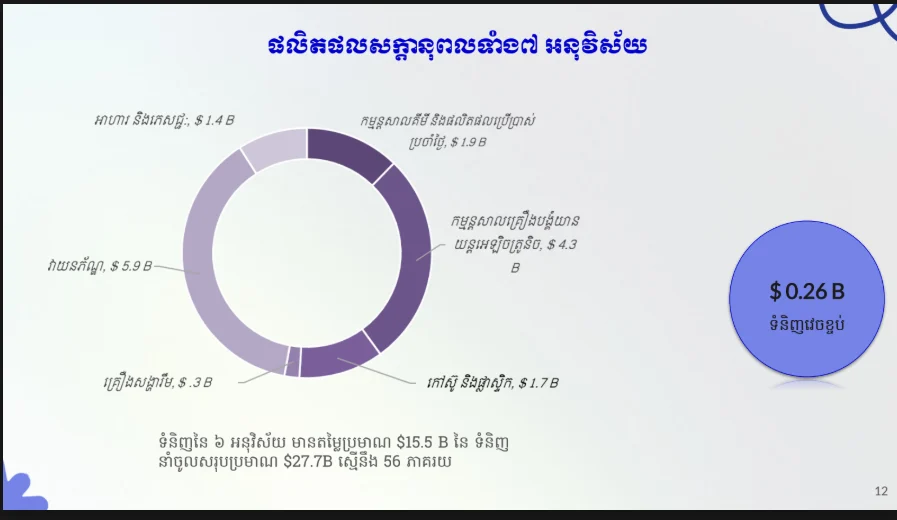
According to data from the Ministry of Industry, from January to October 2025, the import volume of goods within these seven sub-sectors, intended to fulfill domestic product value chains, amounted to approximately $15.76 billion. This figure represents a significant 56% of Cambodia’s total imports, which reached around $27.7 billion during the same period. A detailed breakdown of these imports includes: Textiles at $5.9 billion; Food and Beverages at $1.4 billion; Automotive and Electronics Assembly at $4.3 billion; Furniture at $0.3 billion; Chemical Manufacturing and Daily Use Products at $1.9 billion; and Packaging and Labels at $0.26 billion. It is also important to note that the export volume for these same sub-sectors recorded a notably substantial value.
The Ministry of Industry emphasized that the selection of these seven sub-sectors as priorities stems from their immediate market opportunities and strategic significance in reinforcing Cambodia’s domestic value chains and related industries. This prioritization also aims to encourage Small and Medium-sized Enterprises to recognize and harness the potential within these sub-sectors, fostering the establishment of local manufacturing facilities. The ultimate goal is to reduce reliance on imports and external dependencies, moving Cambodia towards greater independence in production and enhancing its export capacity. Reaffirming the vital role of SMEs, Minister Hem Vanndy stated, “Small and Medium-sized Enterprises play a crucial role in driving economic diversification, creating employment, developing specialized and technical skills, fostering entrepreneurship, and spurring technological innovation to ensure vibrant and sustainable economic growth.”