
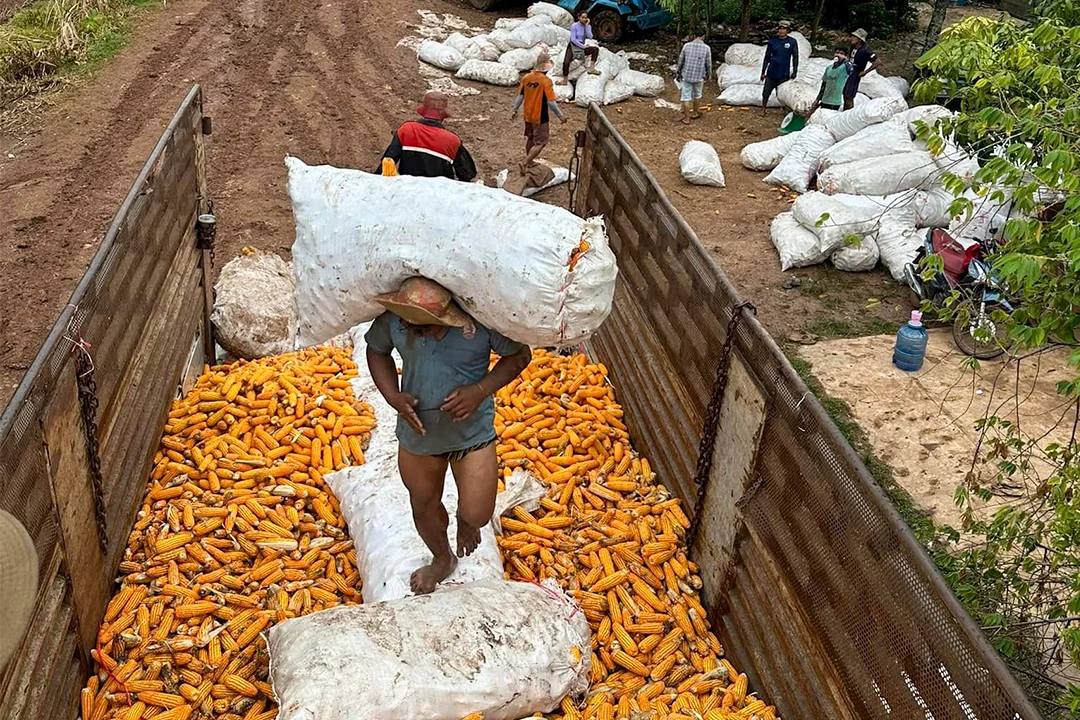
Phnom Penh, Cambodia – Farmers cultivating red corn across Cambodia are facing significant challenges, as rapid price fluctuations in the market, coupled with rising costs for essential agricultural inputs like fertilizer, pesticides, and fuel, have severely impacted their profitability. The confluence of these factors, alongside unpredictable climate changes, has led to a doubling of production costs, leaving many farmers struggling to make a living. In response, these farmers are urging relevant ministries to intervene and help stabilize market prices, emphasizing that erratic price swings often force them to sell their harvest quickly to cover immediate expenses and debts, frequently resulting in financial losses.
Mr. Sieng Ra, a farmer from Malai district in Banteay Meanchey province, clarified that while border disputes between Cambodia and Thailand have not significantly affected the price or market for red corn among farmers near the border – as most of the produce is supplied to local processing factories – the current late harvest season has seen relatively good prices. Corn kernels with 30 percent moisture content are selling for approximately 800 Riel per kilogram, while cobs with similar moisture content fetch over 600 Riel.
However, despite this year’s prices being somewhat better than the previous year, Mr. Sieng Ra expressed deep concern over dwindling profits. He explained that the sharp increase in production costs, particularly for fertilizer, pesticides, and fuel, combined with adverse climate conditions that have led to a significant 40 percent reduction in yield, has negated any gains from higher market prices.
“Overall, prices this year are good compared to last year,” Mr. Sieng Ra stated, “but if we only look at this year, farmers are not making much profit because we face numerous challenges. Firstly, the drought has caused yields to drop. Secondly, the rising fuel prices have made land preparation and plowing much more expensive. Furthermore, the prices for seeds, fertilizers, and agricultural chemicals have increased by 30 to 40 percent compared to previous years.”
Beyond the burden of high input costs, Mr. Sieng Ra, who cultivates red corn on 40 hectares, highlighted another critical issue: the inherent inconsistency of market prices. This unpredictability compels farmers to harvest and sell their crops urgently to pay for fertilizers, pesticides, and outstanding loans. Such hurried sales often mean farmers can only break even, and sometimes even incur losses.
The volatile price movements, which can fluctuate multiple times a day, are believed to stem partly from middlemen and partly from purchasing companies or factories dictating lower prices. Faced with this instability, Mr. Sieng Ra reiterated his plea for government intervention to ensure stable market prices for farmers.
He further elaborated on the severity of the situation: “Red corn prices can go up and down three to four times in a single day. Therefore, I and all other farmers wish for the relevant parties to help prevent such rapid price changes. Most farmers owe money to banks and for agricultural inputs; they need to sell quickly to avoid accumulating more interest. Even if prices are low, they are forced to sell and cannot afford to store their harvest for long because of this market instability, which erodes their confidence.”
Similarly, Mr. Tim Sophon, a red corn farmer from Sampov Loun district in Battambang province, corroborated that while current market prices for red corn are favorable, his overall profitability remains low. He attributed this to a severe drought that led to a loss of nearly 20 tons of corn yield, compounded by the substantial increase in fertilizer, pesticide, and fuel costs since the start of cultivation.
This farmer, who cultivates 20 hectares, recalled that during the land preparation and planting phases, fuel prices soared to 8,000 Riel per liter. Simultaneously, the costs of seeds, fertilizers, agricultural chemicals, and even labor for spraying pesticides, have doubled.
“Current prices are good,” Mr. Tim Sophon conceded, “but when we calculate everything, our profit is minimal because the drought severely reduced my corn yield. Furthermore, the global crisis also impacted us, as fuel prices were very high when we planted, and seeds, fertilizers, and chemicals also increased. So, if we account for all the costs – fertilizer, chemicals, labor, and plowing – we barely make any profit at all.”
Mr. Sophon also emphasized the problem of unclear and fluctuating prices, which makes farmers highly vulnerable to losses, particularly as they lack the financial reserves to store corn for extended periods. For Mr. Tim Sophon and his peers, there is little confidence in the current market prices. Their sole hope is to sell their corn at a good enough price to repay bank loans and cover the costs of seeds, fertilizers, and pesticides.
He concluded: “Currently, everyone is indebted to banks. For red corn cultivation, we have no capital other than what we borrow from the banks. We hope for a good yield and favorable prices to settle our debts with the bank and perhaps have some left over to continue cultivating. When prices fluctuate so erratically, we face extreme difficulties and it becomes very hard to make any profit.”
Red corn is predominantly cultivated in provinces bordering Thailand, including Battambang, Banteay Meanchey, Oddar Meanchey, Pailin, Preah Vihear, and Siem Reap. It is also grown in several provinces along the Mekong and Bassac rivers, such as Kampong Cham and Tboung Khmum. These provinces collectively boast an estimated cultivation area of approximately 280,000 hectares, according to the Agricultural and Rural Development Bank (ARDB) as of 2024.