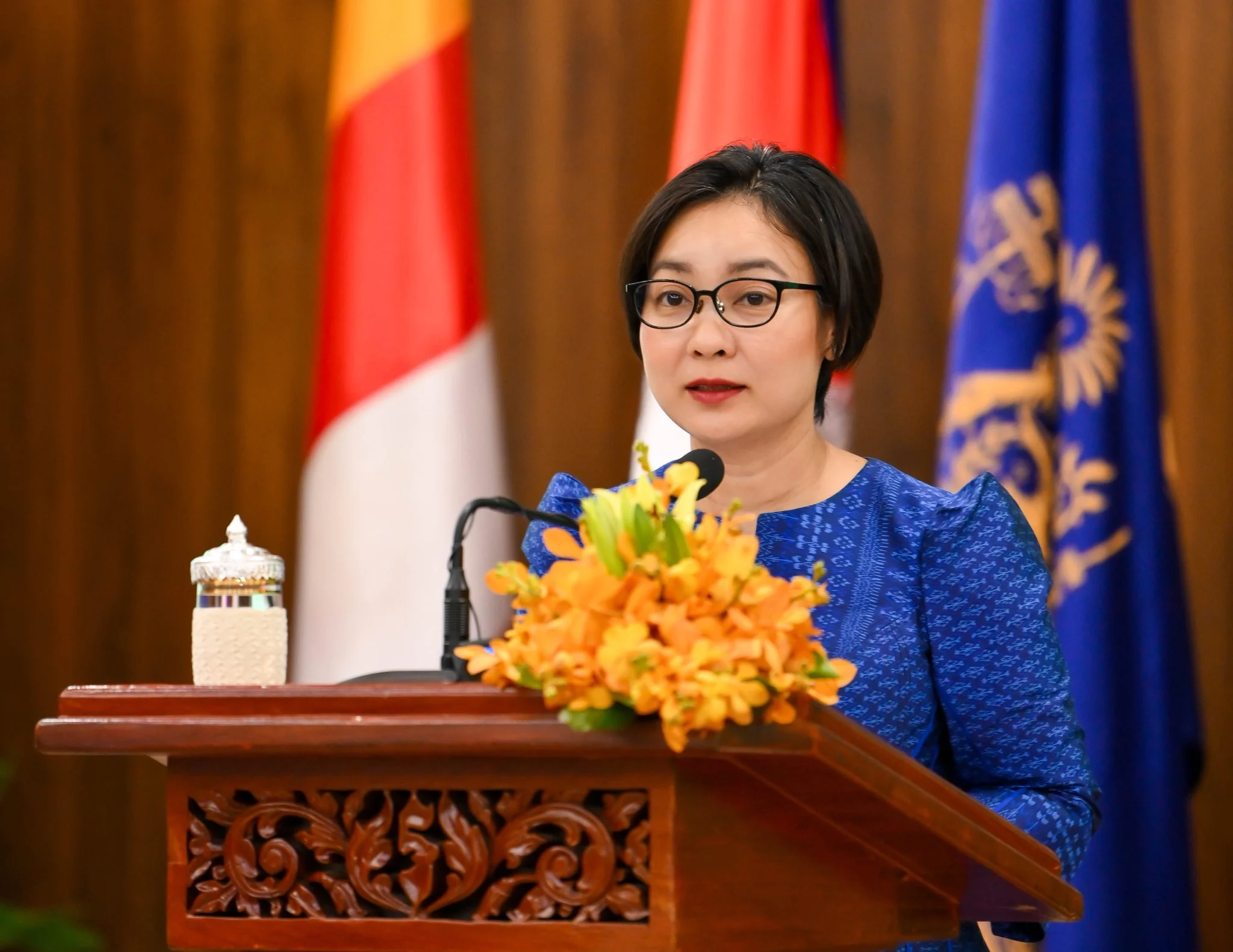
Phnom Penh – Mrs. Chea Serey, Governor of the National Bank of Cambodia (NBC), has stepped forward to provide a comprehensive explanation of banking principles, addressing recent instances where customers reportedly rushed to withdraw funds from financial institutions. Her remarks aim to reassure the public and clarify the operational dynamics of the country’s financial system.
The fundamental role of a bank is to serve as an intermediary, channeling funds from individuals and entities with surplus money — those not immediately needing their cash — to borrowers who require capital for economic activities. This vital process includes financing major purchases like homes, enabling business expansion, and supporting the construction of factories. By facilitating this flow, banks ensure that idle funds are put to productive use, thereby keeping the economic circulatory system vibrant and operational.
Typically, when a bank receives deposits from its customers, it retains only a small fraction of these funds as reserves to meet the immediate withdrawal needs of depositors. The majority is lent out. According to Governor Chea Serey, depositors who do not foresee an immediate need for their funds can opt for fixed-term deposits, choosing durations such as three months, six months, nine months, or even a year, based on their personal financial planning. Nevertheless, all customers require access to a portion of their funds for daily expenses, including grocery shopping, rent payments, and utility bills.
“Through its past experience, a bank knows precisely how much cash it generally needs to hold in its vaults each day to facilitate customer withdrawals,” stated Mrs. Chea Serey.
The Governor further elaborated that funds placed in fixed-term deposits are subsequently extended as loans to borrowers. Loans from banks are typically granted for extended periods; for instance, a homebuyer might secure a mortgage for up to 20 years, while a business expanding its operations could borrow for five years or even longer, depending on their specific requirements. This lending activity forms the core operation of a bank. Therefore, over the long term, banks consistently maintain sufficient liquidity to fulfill depositors’ withdrawal requests.
“However, if all depositors rush to withdraw their money from a financial institution simultaneously, the bank will inevitably face a liquidity shortage,” Mrs. Chea Serey explained. “This occurs because the bank cannot circulate funds quickly enough, as the deposited money has already been loaned out, often for long durations.”
She further clarified, “Should all depositors attempt to withdraw their entire savings at once, it is a normal and expected outcome that the bank would not have all the cash readily available to provide to every single customer.”
Nevertheless, Mrs. Chea Serey firmly asserted that Cambodia’s banking system remains robust and stable in its current state. She highlighted the extensive network of financial institutions operating in the country, noting that by 2025, Cambodia will feature 59 commercial banks, 4 deposit-taking microfinance institutions, 7 specialized banks, 85 non-deposit-taking microfinance institutions, 12 financial leasing institutions, 89 rural credit institutions, 4 third-party processors, 30 payment service providers, 1 credit information sharing company, 5 foreign bank representative offices, and 3,395 money changers.
“For all banks currently operating, the vast majority of customers are still conducting their transactions normally,” Mrs. Chea Serey stated, urging the public: “Therefore, we ask all citizens to allow the National Bank of Cambodia time to continue working with the relevant banks to find solutions for depositors’ funds.”
The Governor’s comprehensive explanation comes in the wake of several instances where customers rushed to withdraw funds from various banks. Notably, on March 16, customers of APD Bank were also observed making urgent withdrawals from the institution.